A more comfortable summer bedroom starts well before bedtime. If you live on the Central Coast in New South Wales, think about daytime sunlight, evening ventilation and what you actually need a cooling device to do.
This guide helps you prepare the room and compare personal cooling features without assuming that a compact device can control the temperature throughout a bedroom.
What the Gosford climate record tells us
The Bureau of Meteorology’s Gosford AWS station (061425) lists a January mean maximum temperature of 28.0°C and a January mean minimum of 19.1°C. The table consulted on 8 October 2026 shows 13 years of available temperature observations within the 2013–2026 record span.
These are historical outdoor station averages, not current forecasts or measurements in your bedroom. A mean minimum temperature does not tell you what the temperature will be at bedtime, nor does it guarantee a cool night.
Gosford is one observation location, not a measurement of every Central Coast suburb. The summary table does not provide monthly humidity averages, so check your actual room conditions rather than attaching an unsupported humidity figure to the region.
Limit daytime heat before choosing a device
Notice when direct sun reaches your bedroom windows. Close suitable curtains or blinds before sunlight warms the room, and move seating out of sunbeams if you use the bedroom during the day.
Switch off unnecessary electrical equipment and keep appliance ventilation openings clear. Choose bedding that feels comfortable for the conditions rather than relying on cooling equipment to compensate for every source of discomfort.
Reassess ventilation in the evening
Check whether outdoor air is cooler than indoors before opening windows. Consider air quality, security and the instructions for your cooling equipment. Darkness does not automatically mean outdoor air is cooler.
Evaporative cooling and refrigerated air conditioning may need different ventilation arrangements. Follow the manufacturer’s requirements instead of applying one window routine to every device.
Decide between personal comfort and room cooling
A fan provides airflow without refrigerating the room. Many water-based personal coolers use evaporation, which generally works better in dry conditions. Their cooling effect becomes more limited as humidity rises, and they add moisture.
For lowering the temperature throughout an enclosed bedroom, consider appropriately sized refrigerated air conditioning. Portable models typically require an exhaust hose vented outdoors, along with suitable window installation and any necessary drainage.
Read specifications rather than relying on product names containing “mini”, “portable” or “AC”. Mist is not dehumidification, and adding ice does not convert a water-based device into a refrigerated air conditioner.
Compare bedroom-friendly controls carefully
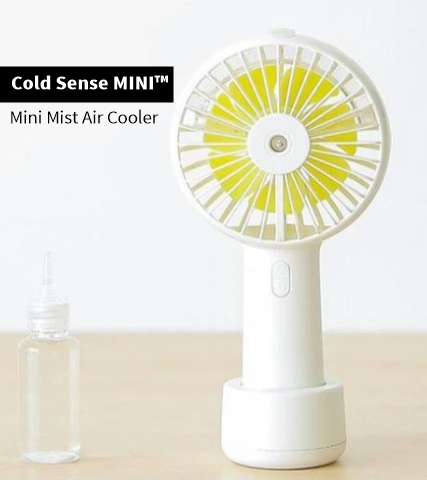
The Cold Sense 2.0 listing describes three fan speeds, two mist settings, a 900 ml tank, a timer and a night light that can be switched off. These features are useful to compare when considering a personal device for use while relaxing before bed.
A switchable light may suit your preferences, but it does not establish quieter operation or improved sleep. A timer does not by itself prove that unattended or overnight use is appropriate. Check the current operating instructions and noise information before deciding how to use a device.
Consider whether mist is suitable for your room’s humidity and ventilation. Do not assume a guaranteed temperature reduction from adjustable controls.
Make placement and maintenance part of the routine
Keep water-based devices on an appropriate stable surface away from electrical equipment. Leave the required clearances, keep cords out of walkways and follow instructions about water changes and tank cleaning.
Do not position equipment where bedding can obstruct an inlet or outlet. Before switching off the lights, check that the setup remains safe and that you are using the device only as instructed.
Your pre-bed checklist
- Check the current forecast, warnings and room conditions.
- Decide whether outdoor conditions permit suitable ventilation.
- Confirm equipment placement, clearances and cord routing.
- Check instructions for overnight or unattended operation.
- Maintain any water tank according to the manufacturer’s guidance.
Have a plan for unsafe heat
Follow local weather warnings and public-health advice during extreme heat. Identify a cooler place you can go if your bedroom becomes unsafe and consider power interruptions. Personal cooling devices are not a substitute for a heat-safety plan.
Prepare the room, then choose your cooling
Start with shade and sensible ventilation, then choose technology for your actual goal. If a personal device suits your needs, explore Cold Sense 2.0 and review its specifications and operating instructions before ordering.
Climate source: Bureau of Meteorology: Gosford AWS monthly climate statistics, station 061425. Consulted 8 October 2026. These historical outdoor averages are not live forecasts or measurements across the entire Central Coast.