If you’re looking for a personal air cooler in Brisbane, temperature is only part of the picture. Humidity matters too, particularly when you’re considering a water-based device that uses evaporation.
The short answer: an evaporative personal cooler may provide nearby comfort in suitable conditions, but its cooling effect becomes more limited as humidity rises. It is not a replacement for refrigerated air conditioning when you need to cool an entire room.
What Brisbane’s summer climate tells us
The Bureau of Meteorology’s Brisbane station (040913) lists a January mean maximum temperature of 30.4°C for its available temperature record, shown as 1999–2026 in the table consulted on 8 October 2026. Its January mean relative humidity at 3 pm is 57%, based on a separate 1999–2010 record.
These are historical outdoor station averages, not today’s forecast or measurements inside your home. The different observation periods also mean they should not be treated as a single snapshot of current conditions. Your suburb, building, ventilation and time of day can all affect what you experience.
The useful takeaway is to consider both temperature and humidity before choosing cooling, rather than assuming that every hot day calls for the same device.
Why humidity affects evaporative cooling
Many water-based personal air coolers pass air through a damp cooling medium. As water evaporates, it takes heat from the air. This process generally works better when the incoming air is dry.
When air already contains more moisture, there is less scope for evaporation. The fan may still provide airflow, but the evaporative cooling effect can be reduced. These devices also add moisture to the air, so using one in a poorly ventilated enclosed room can make conditions more humid.
Adding ice does not change the device into a refrigerated air conditioner. Avoid choosing a product on the assumption that it will maintain a set room temperature unless its specifications explicitly support that function.
Personal cooling or whole-room cooling?
Start with what you want to achieve. For airflow near a desk or chair, a personal device may be an option, subject to its specifications and the conditions where you use it. Check the recommended positioning and avoid assuming it will cool the entire room.
If you need to lower the temperature throughout a bedroom or living space, consider a suitably sized refrigerated air conditioner. Portable models typically need an exhaust hose vented outdoors. Many also remove moisture during cooling, with drainage requirements that vary by model.
A conventional fan is another option for airflow without adding water vapour. It does not refrigerate the room, but it serves a different purpose from a water-based cooler.
What to check before buying in Brisbane
- Confirm the technology: evaporation, refrigeration or simply fan-driven airflow.
- Check whether the device is intended for nearby personal comfort or whole-room cooling.
- Read ventilation, placement, cleaning and water-maintenance instructions.
- For a portable air conditioner, check cooling capacity, window-kit compatibility and drainage requirements.
- Consider actual indoor humidity rather than relying only on a city-wide climate average.
A household thermometer and hygrometer can help you understand your workspace or bedroom, but no single humidity reading guarantees a particular product’s performance. Use the manufacturer’s operating guidance.
Make your room more comfortable first
Shade windows before strong sunlight enters, move your desk out of direct sun and switch off unnecessary heat-producing equipment. Ventilate when outdoor conditions are suitable and cooler than indoors, considering air quality and the instructions for your cooling device.
During extreme heat, follow local weather warnings and public-health advice. Personal cooling products are not a substitute for a heat-safety plan or access to a cooler place.
The bottom line for Brisbane
Humidity makes realistic expectations especially important. Choose a personal evaporative cooler for its stated intended use, not as a shortcut to whole-room air conditioning.
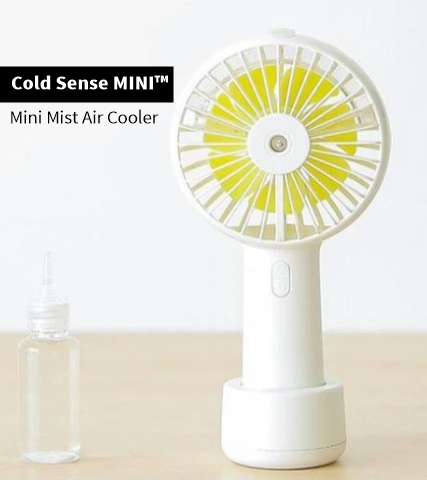
If you’re exploring the Cold Sense range, check each model’s cooling technology, operating conditions and care instructions before deciding whether it suits your Brisbane home.
Climate source: Bureau of Meteorology: Brisbane monthly climate statistics, station 040913. Consulted 8 October 2026. These historical statistics are not a live weather forecast.