

When the Australian summer arrives, a more comfortable home office or bedroom can make a big difference. But before choosing a cooling device, it’s worth understanding what you’re buying.
A personal air cooler and a portable air conditioner may look similar in an online listing, but they aren’t necessarily designed to do the same job. Here’s how to tell them apart and choose an option that suits your space.
What is a personal air cooler?
“Personal air cooler” is a broad label, so always check how a particular model works. Many water-based personal coolers use evaporation: a fan moves air through a damp cooling medium, creating a cooling effect as water evaporates.
These devices are generally intended for local comfort, such as beside you at a desk, rather than controlling the temperature of an entire room.
Evaporative cooling works best in dry conditions. When the air is already humid, evaporation is less effective. Ventilation also matters, because using a water-based cooler in an enclosed space can increase humidity.
What is a portable air conditioner?
A portable air conditioner uses a refrigeration system to remove heat from indoor air. Typically, it sends that heat outside through an exhaust hose fitted to a window.
Unlike a personal evaporative cooler, a suitably sized portable air conditioner is designed to cool an enclosed room. Its performance depends on factors including room size, insulation, sunlight, outdoor temperature and installation.
Many models also remove moisture from the air during cooling. Check the product instructions for drainage requirements and allow room for the exhaust hose before buying.
Which option suits your space?
Start with your goal. Are you looking for a cooling effect close to where you sit, or do you want to lower the temperature throughout a room?
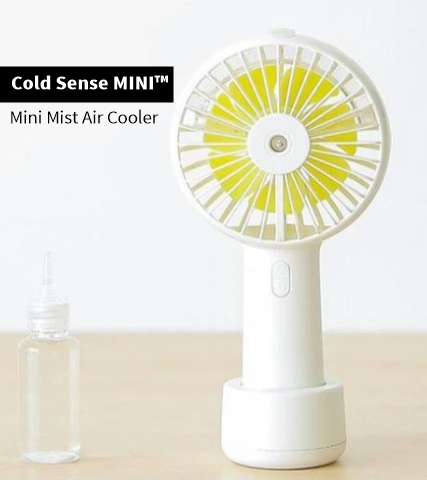
For personal comfort at a desk, a compact cooler may be worth considering, particularly in dry conditions. Check its recommended placement, water requirements and maintenance instructions.
For whole-room cooling, look for an air conditioner with a cooling capacity suitable for your space. You’ll also need a practical way to vent the exhaust outdoors.
Australia’s climate varies considerably, so don’t choose based on the season alone. Consider the humidity where you live and the conditions inside the room you actually use.
What should you check before buying?
Look beyond words such as “portable”, “mini” or “AC” in a product title. Read the specifications to confirm whether the device uses evaporation or refrigeration.
Check its intended coverage, dimensions, power requirements, noise information and cleaning instructions. For an air conditioner, check the window-kit requirements too. For a water-based cooler, check how the tank and cooling medium should be maintained.
If energy use is important to you, compare the rated power and expected operating time. A smaller device may use less electricity, but it may also provide a very different level of cooling. Lower power consumption doesn’t automatically mean equivalent performance.
The bottom line
Choose for the job you need done. Personal cooling and whole-room air conditioning serve different purposes, and understanding that difference helps you set realistic expectations.
Explore the Cold Sense range and check each model’s specifications to find the option that fits your space, routine and local conditions.